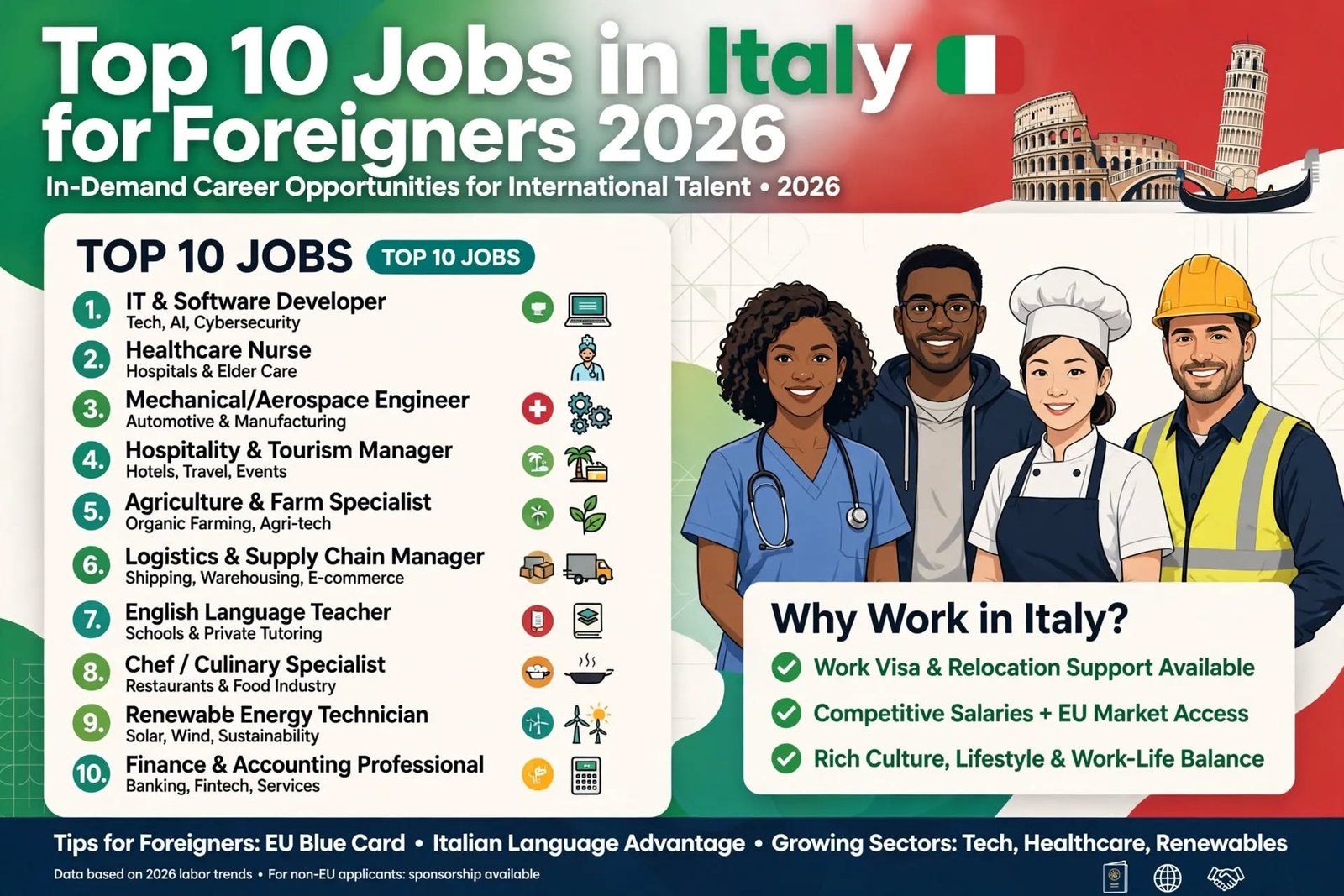
Italy is famous for food, fashion and history, but its labour market tells a quieter story. The population is ageing, many employers cannot find enough workers, and the government has opened the door wider to foreign talent than at any time in recent years. If you have been searching for jobs in Italy for foreigners, 2026 is a genuinely good moment to take the idea seriously.
There is a catch, of course. Italy does not hand out work visas freely. Most non-EU citizens need a job offer from an Italian employer, and a large share of permits are limited by annual quotas. Salaries are also lower than in Germany or the Netherlands, though living costs outside Milan are often gentler too.
This guide walks you through the ten most promising job categories, what they realistically pay, which visa routes fit each one, and where to start applying. Every salary figure here is an indicative gross annual range, not a promise. Pay varies by region, employer size and the national collective agreement (CCNL) of your sector.
How Work Visas for Foreigners in Italy Work in 2026
Before choosing a career, understand the legal doorway you will use. Your nationality matters first: EU, EEA and Swiss citizens can live and work in Italy freely, with no visa at all. Everyone else needs permission.
The Decreto Flussi (Annual Quota System)
The decreto flussi is the government decree that sets how many non-EU workers may enter Italy each year. The 2026–2028 decree allows about 497,550 entries over three years, with roughly 164,850 places for 2026. A large portion is reserved for seasonal work in agriculture and tourism, while a smaller portion covers non-seasonal employment such as care work, construction and hospitality.
The process works like this:
- An Italian employer applies for a nulla osta (work authorisation) through the Ministry of the Interior’s online portal on a designated “click day”.
- If approved, you apply for a work visa at the Italian consulate in your home country.
- After arriving, you sign your contract and request a permesso di soggiorno (residence permit) within eight days.
Because places are limited and employers compete for them, speed and preparation matter. Applications for 2026 opened in early 2026, and you generally cannot apply twice in the same year. Dates and quota details change, so always confirm on the official Ministry of the Interior or Italian consulate websites.
The EU Blue Card (For Highly Skilled Professionals)
The EU Blue Card Italy is the best route for graduates and experienced specialists such as developers, engineers and data scientists. It sits outside the decreto flussi quota, so you do not compete for a limited slot. You need a recognised degree or equivalent professional experience, plus a qualifying job offer above a minimum salary threshold. The threshold is tied to Italian pay levels and is updated over time, so check the current figure with the consulate or Ministry before you negotiate a contract.
Blue Card uptake in Italy has historically been low compared with Germany, so employers may be less familiar with it. Be ready to explain the process politely and point them to the official guidance.
Other Routes Worth Knowing
- Seasonal work permit: For farm and tourism jobs, with fixed-period contracts.
- Intra-company transfer: If a multinational moves you to its Italian branch.
- Self-employment and freelance visas: Quotas here are very small, so they are hard to secure.
- Student visa conversion: Studying in Italy and later converting your permit to a work permit is a popular long-term strategy.
Top 10 Jobs in Italy for Foreigners in 2026
1. Software Developer
Tech talent is scarce across Italy, especially in Milan, Turin, Bologna and Rome. Companies need backend, frontend, mobile and cloud engineers, and many international firms work in English.
- Typical salary: €30,000–€50,000 per year, with senior roles above €55,000
- Best visa route: EU Blue Card or employer sponsorship
- Where to apply: LinkedIn, Indeed Italy, Honeypot-style tech boards, company career pages
- Tip: A strong GitHub profile often matters more than a long CV.
2. Nurse and Healthcare Professional
Italy’s ageing population has created a persistent shortage of nurses, care assistants and some medical specialists. Private clinics and care homes recruit actively, and part of the decreto flussi is specifically set aside for family-care and health-care workers.
- Typical salary: €22,000–€32,000 per year for nurses; higher for specialist doctors
- Best visa route: Decreto flussi (care sector) or professional work visa
- Where to apply: Private hospital group websites, regional health authority portals, specialist recruitment agencies
- Important: Your foreign qualification must be recognised by the Italian Ministry of Health, and you will need solid Italian.
3. Data Analyst and Data Scientist
From banking in Milan to manufacturing in the north-east, Italian companies are investing in analytics and AI. Skills in SQL, Python, Power BI and machine learning are in demand.
- Typical salary: €28,000–€48,000 per year
- Best visa route: EU Blue Card
- Where to apply: LinkedIn, Glassdoor, Kaggle communities, consulting firm career pages
4. Cybersecurity Specialist
As Italian businesses digitise, security professionals are increasingly valuable. Roles include security analyst, penetration tester and compliance specialist.
- Typical salary: €32,000–€55,000 per year
- Best visa route: EU Blue Card
- Where to apply: LinkedIn, specialist IT recruiters, banks and consulting firms
- Tip: Certifications such as CISSP, CEH or ISO 27001 lead auditor strengthen your case considerably.
5. Electrician and Renewable Energy Technician
Solar, wind and building-efficiency projects have boosted demand for skilled electrical workers. Skilled tradespeople are among the hardest roles for Italian employers to fill.
- Typical salary: €20,000–€32,000 per year, rising with specialist certification
- Best visa route: Decreto flussi non-seasonal work permit
- Where to apply: Installation company websites, Subito.it, Infojobs, local employment centres
- Tip: Italian trade certifications and basic Italian are major advantages.
6. Chef and Hospitality Worker
Tourism is one of Italy’s biggest industries, and restaurants, hotels and resorts constantly need cooks, bartenders, receptionists and housekeeping staff. Many hospitality jobs qualify under the seasonal quota.
- Typical salary: €18,000–€35,000 per year, with head chefs earning more
- Best visa route: Seasonal work permit or decreto flussi
- Where to apply: Hosco, Indeed Italy, direct applications to hotels and resorts
- Tip: Apply months before the season starts, since employers must file quota requests early.
7. Mechanical and Automation Engineer
Italy is a manufacturing powerhouse, home to automotive, machinery, packaging and robotics firms. Engineers who understand PLC programming, CAD or industrial automation are valued, especially in Lombardy, Emilia-Romagna and Veneto.
- Typical salary: €28,000–€45,000 per year
- Best visa route: EU Blue Card or employer sponsorship
- Where to apply: LinkedIn, Randstad, Adecco, large manufacturer career pages
8. Logistics and Supply Chain Professional
E-commerce growth and Italy’s position as a European transport hub keep logistics roles in demand: warehouse operators, forklift drivers, planners and supply chain analysts.
- Typical salary: €20,000–€38,000 per year, depending on role
- Best visa route: Decreto flussi for operational roles; Blue Card for analysts and managers
- Where to apply: Randstad, Manpower, Indeed Italy, logistics company career pages
9. Digital Marketing Specialist
Italian small and medium businesses are moving online, creating roles in SEO, paid advertising, social media and e-commerce. International companies also hire English-speaking marketers for global campaigns, which can allow remote or hybrid work.
- Typical salary: €24,000–€40,000 per year
- Best visa route: Employer sponsorship, or a student-to-work permit conversion
- Where to apply: LinkedIn, Indeed, startup job boards, digital agency websites
10. Construction and Skilled Trades Worker
Bricklayers, carpenters, welders, plumbers and site supervisors are needed across the country, helped by renovation incentives and infrastructure projects. Construction is one of the named sectors in the non-seasonal quota.
- Typical salary: €18,000–€30,000 per year, with supervisors earning more
- Best visa route: Decreto flussi non-seasonal permit
- Where to apply: Construction company websites, local employment agencies, Infojobs
- Important: Safety training certificates are mandatory on Italian sites.
Salary Snapshot: What Can You Realistically Expect?
| Job | Indicative gross annual salary | Easiest visa route |
|---|---|---|
| Software developer | €30,000–€50,000+ | EU Blue Card |
| Nurse / healthcare | €22,000–€32,000 | Decreto flussi / professional visa |
| Data analyst / scientist | €28,000–€48,000 | EU Blue Card |
| Cybersecurity | €32,000–€55,000 | EU Blue Card |
| Electrician / renewables | €20,000–€32,000 | Decreto flussi |
| Chef / hospitality | €18,000–€35,000 | Seasonal / decreto flussi |
| Mechanical / automation engineer | €28,000–€45,000 | EU Blue Card |
| Logistics / supply chain | €20,000–€38,000 | Decreto flussi |
| Digital marketing | €24,000–€40,000 | Sponsorship / conversion |
| Construction / trades | €18,000–€30,000 | Decreto flussi |
Remember that Italian salaries are quoted gross (RAL), and take-home pay is lower after income tax and social contributions. Many contracts also include a thirteenth month (and sometimes a fourteenth), paid as extra salary, so ask how the annual figure is divided.
Where to Apply: Best Job Portals and Resources
- LinkedIn Jobs: Best for professional, corporate and tech roles. Set your location to Italy and enable job alerts.
- Indeed Italy: Wide coverage across all sectors, from hospitality to engineering.
- InfoJobs and Subito Lavoro: Strong for trades, local businesses and small employers.
- Randstad, Adecco, Manpower, Gi Group: Major recruitment agencies placing workers in logistics, industry and administration.
- Hosco: Specialist hospitality and tourism job board.
- EURES (European Employment Services): Official EU portal, useful for verified vacancies.
- Company career pages: Large Italian and multinational employers often advertise roles here before anywhere else.
A safety warning: Never pay an agent or “consultant” for a guaranteed Italian visa or job. Legitimate employers do not charge you for a nulla osta. If someone demands money upfront, treat it as a red flag and verify everything through official government channels.
Practical Tips to Boost Your Chances
- Learn basic Italian. Even A2 level shows commitment, and it is essential for healthcare, trades and customer-facing jobs.
- Tailor your CV to the Italian format. Keep it clear, include a professional photo only if the employer expects it, and add the privacy consent line commonly used in Italy.
- Get your qualifications recognised. Regulated professions need official recognition. Start early because it can take months.
- Apply early for quota-based jobs. Employers need time to prepare decreto flussi applications.
- Build a LinkedIn profile for Europe. Add keywords from job descriptions, and mention your visa needs honestly.
- Target regions with more jobs. Lombardy, Emilia-Romagna, Veneto, Piedmont and Lazio offer the largest labour markets.
- Consider studying first. A master’s degree in Italy can open doors to local networks and an easier permit conversion.
Cost of Living: Does the Salary Stretch?
A €28,000 gross salary may sound modest, but Italy can be affordable outside the biggest cities. Rent in Milan is far higher than in Bologna, Padua or smaller southern cities. Public healthcare is available to residents who register, and fresh food is generally good value. Plan your budget by city, not by country, and compare real rental listings before accepting an offer.
Conclusion
Italy offers real opportunities for foreign workers in 2026, especially in technology, healthcare, skilled trades, hospitality and manufacturing. The ten jobs above combine strong demand with realistic visa pathways, though success depends on choosing the right route, preparing early and avoiding scams.
Your next steps are simple: pick the career that matches your skills, check whether you qualify for the EU Blue Card or need an employer to file under the decreto flussi, update your CV, start learning Italian, and apply through trusted portals. Always confirm the latest quota dates, salary thresholds and document requirements with the official Italian authorities, because rules change.
Frequently Asked Questions (FAQ)
Can a foreigner get a job in Italy without speaking Italian?
Yes, in some cases. International tech companies, multinationals and some hospitality employers use English. However, most jobs, especially in healthcare, trades and customer service, expect at least basic Italian, and it greatly improves your prospects.
Which job in Italy is easiest to get a visa for?
Seasonal agriculture and tourism jobs have the largest quotas, so they are often the most accessible. For skilled professionals, the EU Blue Card avoids the quota competition altogether.
What is a nulla osta?
It is the work authorisation issued by Italian authorities after an employer’s application. You need it before you can apply for your work visa at the consulate.
Can I look for a job in Italy while living abroad?
Yes. Most foreigners search remotely through LinkedIn, EURES and recruitment agencies. You will still need an employer willing to sponsor you, so tailor your applications and be clear about your visa situation.
How much money do I need to live comfortably in Italy?
It depends on the city. A single person can often live reasonably on a net income of €1,500–€2,000 per month outside Milan and Rome, but rent is the major variable.
Can I bring my family to Italy?
Family reunification is possible once you hold a valid residence permit and meet income and housing requirements. EU Blue Card holders generally enjoy more favourable family rights.
Is the information in this article legal advice?
No. This article is for general guidance. Salaries and visa rules change, so verify details with official Italian government sources or a qualified immigration lawyer before making decisions.
One comment