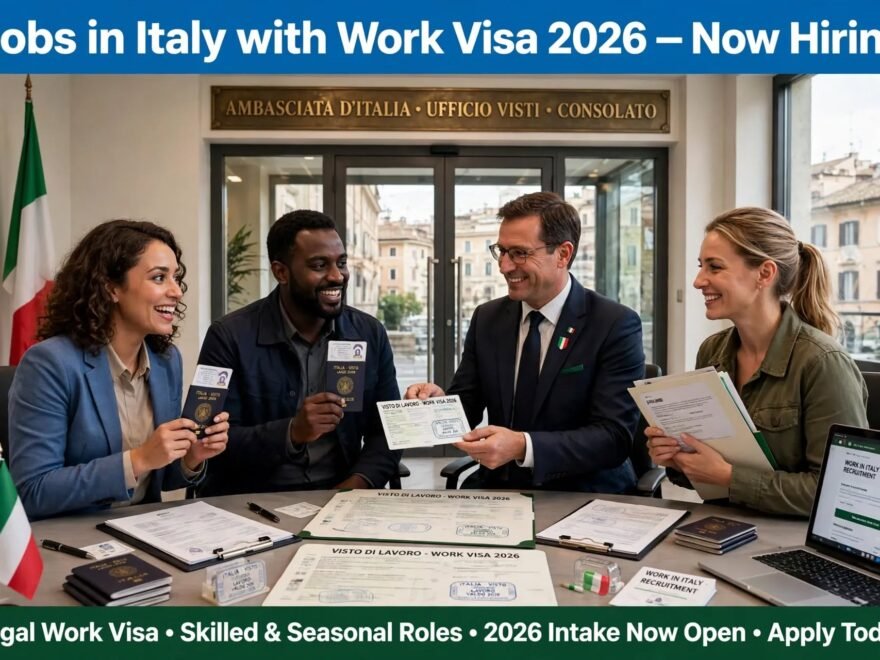
Jobs in Italy with Work Visa: Italy is famous for its food, fashion, history and lifestyle. It is also a country with a real labor shortage. An aging population, a shrinking workforce and growing demand in tourism, agriculture, construction, healthcare and manufacturing have pushed Italian employers to look beyond their borders for talent.
If you are searching for jobs in Italy with a work visa, the news is encouraging, but the process is not casual. Italy does not allow most non-EU citizens to simply fly in and look for work. In most cases you need a job offer from an Italian employer, an approved nulla osta (work authorization), and a national work visa before you travel.
This guide walks you through the whole journey step by step. You will learn which visa routes exist, which sectors are hiring, how the Italian system actually works, how to find genuine employers, and how to avoid the scams that target hopeful applicants every year.
Can Foreigners Really Get Jobs in Italy with a Work Visa?
Yes. Every year Italy opens a quota of work permits for non-EU citizens through a system called the Decreto Flussi (the “flows decree”). Recent decrees have planned several hundred thousand entries over a multi-year period, covering seasonal and non-seasonal work. Exact numbers, sectors and dates change with each decree, so always confirm them on official Italian government sources.
Read Also: Remote and Digital Marketing Jobs in Italy: What Employers Want
Who does not need a work visa?
- Citizens of EU and EEA countries and Switzerland, who can live and work in Italy freely
- Non-EU citizens who already hold a valid Italian residence permit that allows work
Who needs one? Almost everyone else, including citizens of India, Pakistan, Bangladesh, the Philippines, Nigeria, Egypt, Morocco, the United States, the UK and many other countries.
Understanding the Main Types of Italian Work Visas
Choosing the right route is the most important decision you will make. Here are the main options.
1. Subordinate Work Visa (Lavoro Subordinato)
This is the standard route for people who will work as employees under a contract. It is usually issued under the Decreto Flussi quota. Your Italian employer applies for authorization on your behalf, and once it is granted, you apply for the visa at the Italian consulate in your country.
2. Seasonal Work Visa (Lavoro Stagionale)
Designed for temporary work in agriculture and tourism-hospitality, such as harvest work, hotels, resorts and restaurants. Seasonal permits are generally limited in duration, and in some cases workers who return in following seasons get easier procedures.
3. EU Blue Card
For highly qualified professionals with a university degree (or equivalent higher qualification) and a job offer with a salary above the required threshold. It suits engineers, IT specialists, doctors, researchers and managers.
4. Self-Employment Visa (Lavoro Autonomo)
For freelancers, entrepreneurs and professionals who want to work for themselves. It requires proof of funds, a business plan or qualifications, and often a quota slot as well.
5. Intra-Company Transfer and Special Categories
If you work for a multinational company with a branch in Italy, you may qualify for a transfer permit. Researchers, highly skilled workers, sportspeople and other special categories also have dedicated paths.
6. Job Seeker Options
Italy does not offer a general-purpose “come and look for a job” visa to most nationalities. Beware of any agent who claims otherwise. Some special routes exist, such as for graduates of Italian universities, who may convert a study permit into a work permit. Always verify the current rules.
Which Jobs in Italy Are Open to Foreign Workers?
Demand is strongest in sectors facing persistent shortages. Typical opportunities include:
- Agriculture and farming: fruit picking, vineyard work, dairy farms, greenhouse work
- Tourism and hospitality: hotel staff, cooks, waiters, housekeeping, resort workers
- Construction and skilled trades: bricklayers, electricians, plumbers, welders, carpenters
- Healthcare and caregiving: nurses, nursing assistants, elderly caregivers
- Logistics and transport: warehouse operators, truck drivers, forklift operators
- Manufacturing: machine operators, packaging workers, mechanics, technicians
- Information technology: software developers, cybersecurity specialists, data analysts
- Domestic and family assistance: household help and elder care
Salaries vary widely by sector, region and contract. Italian wages are often governed by national collective labor agreements (CCNL), which set minimum pay, working hours, leave and notice periods. Wages in the north, such as Lombardy and Veneto, are often higher than in the south, though living costs are higher as well.
Step-by-Step Guide: How to Get Hired in Italy from Abroad
Step 1: Identify Your Eligible Category
Before applying anywhere, decide which route fits you. Ask yourself:
- Do I have a degree or professional qualification? (Blue Card or skilled route)
- Do I have trade skills such as welding, cooking or driving? (Subordinate work)
- Am I available for seasonal work in farms or hotels? (Seasonal route)
Matching your profile to the right visa saves months of wasted effort.
Step 2: Prepare an Italy-Ready CV and Documents
Italian employers prefer clear, honest and well-structured applications. Prepare:
- A Europass-style CV, kept to one or two pages
- A short cover letter in English (or Italian if you can)
- Scanned copies of your passport, certificates, degrees and experience letters
- Reference letters from previous employers
- For regulated professions (nursing, engineering, medicine), your qualification documents with certified translations and, where needed, recognition by the Italian authorities
Tip: Include any language skills. Even basic Italian, say A2 level, puts you ahead of many applicants.
Step 3: Learn Basic Italian
You can find roles in international companies using English only, but for most jobs, especially in trades, hospitality and care, Italian is essential. Free and low-cost apps, online courses and YouTube lessons can take you to a functional level in a few months. Employers notice candidates who make this effort, and it also makes your visa interview and settling in much smoother.
Step 4: Find Genuine Job Opportunities
Legitimate places to search include:
- Official and reputable job portals: the EURES portal (the European job mobility network), Indeed Italy, InfoJobs, Subito Lavoro and LinkedIn
- Company career pages of Italian firms in your sector
- Italian recruitment agencies (known as agenzie per il lavoro), which are legally authorized
- Professional networks and industry groups on LinkedIn
- Sector associations in agriculture, tourism and construction, which sometimes support the hiring of foreign workers
Apply to many positions, but personalize each application. Mass-sent generic emails rarely work.
Step 5: Get a Valid Job Offer or Employment Contract
For most non-EU workers, the job offer is the key. Italian law generally requires employers to first verify that no suitable Italian or EU worker is available, and then apply for authorization for you. Your offer should clearly state:
- Employer name and address
- Job title and duties
- Salary and working hours
- Contract type and duration
- Applicable collective agreement (CCNL)
Step 6: Your Employer Applies for the Nulla Osta
This is the heart of the process. Your employer submits an online application to the Sportello Unico per l’Immigrazione (the one-stop immigration desk at the local prefecture) during the periods set by the Decreto Flussi. These submission windows are commonly called “click days”, and competition can be intense because quotas are limited.
If approved, the authorities issue the nulla osta al lavoro, the official work authorization. Processing can take weeks to several months depending on the province and the volume of applications.
Important: The employer, not you, normally files this application. A genuine employer will never ask you to pay for the nulla osta itself.
Step 7: Apply for the Type D Visa at the Italian Consulate
Once the nulla osta is issued and reaches the Italian embassy or consulate in your country, you apply for a national visa (type D) for work. You will typically need:
- A valid passport
- The nulla osta and signed contract or offer details
- Passport-size photographs
- Proof of accommodation arrangements in Italy
- Visa application form and fees
- Sometimes a criminal record certificate or health insurance, depending on your case
Attend the appointment, provide your documents and, if requested, answer questions about your job and plans. Processing generally takes a few weeks.
Step 8: Travel to Italy and Complete Formalities
After arrival, move quickly. Within a short legal timeframe (commonly eight days), you must complete these steps:
- Sign the residence contract (contratto di soggiorno) and finalize your employment paperwork at the Sportello Unico, as instructed in your documents
- Apply for your permesso di soggiorno (residence permit) through the post office kit system, followed by a fingerprint appointment at the police headquarters (Questura)
- Obtain your codice fiscale, your Italian tax ID, which you need for almost everything, including contracts, bank accounts and healthcare
- Register for the national health service and open a bank account
Keep the receipt of your permit application safe. It generally proves you are in the process legally while you wait for the physical card.
Typical Timeline from Application to Arrival
Every case differs, but a rough picture looks like this:
- Job search and offer: 1 to 6 months or more
- Waiting for the quota window and nulla osta: 2 to 6 months or longer
- Visa processing at the consulate: 2 to 8 weeks
- Arrival and permit formalities: the first few weeks in Italy
Overall, plan for six months to a year from the start of your search. Patience and organization are essential.
Estimated Costs to Prepare For
Genuine costs are usually modest compared with what scammers demand. Expect to budget for:
- Visa application and service fees
- Certified translations and document legalization
- Passport and photographs
- Flight tickets and initial living expenses
- Permit fees, including the postal kit and stamp duty for your residence permit
Fees change, so check the current amounts on the official consulate website before you pay anything.
How to Avoid Job and Visa Scams
Unfortunately, many people lose their savings to fake “Italy visa” offers. Protect yourself by watching for these warning signs:
- Agents who sell “guaranteed visas” or guaranteed jobs. No one can guarantee a government decision.
- Requests for large upfront payments for the nulla osta, contract or “quota slot.”
- Job offers that arrive without any interview or real contact with the employer.
- Email addresses from free providers pretending to represent big companies.
- Pressure to pay quickly or via untraceable methods.
How to verify an offer:
- Search for the company in Italian business registers and confirm that it exists.
- Contact the employer directly through official channels.
- Ask the Italian embassy or consulate in your country about the process.
- Remember that the nulla osta is requested by the employer through the official online system, and you can check with the authorities if needed.
Tips to Improve Your Chances of Getting Hired
- Apply early and time your search around the Decreto Flussi periods.
- Target high-demand sectors where employers struggle to find local staff.
- Get your qualifications recognized if you work in a regulated profession.
- Show flexibility about region. Smaller towns often hire more readily than famous cities.
- Build a LinkedIn profile in English and Italian, and connect with recruiters.
- Stay consistent. Many successful candidates apply to dozens of employers before getting a real offer.
Rights and Benefits of Working Legally in Italy
A legal contract protects you. Foreign workers with a valid permit have the right to:
- Wages and conditions at least equal to the collective agreement
- Paid annual leave and public holidays
- Social security and pension contributions
- Access to the national health service
- Protection against unfair dismissal under Italian labor law
- The possibility, after years of legal residence, to apply for a long-term EU residence permit and family reunification
Conclusion
Getting jobs in Italy with a work visa is absolutely possible, but it rewards preparation, patience and honesty. The roadmap is clear: pick the right visa category, prepare strong documents, find a genuine employer, wait for the nulla osta, apply for your type D visa, and complete your formalities after arrival. Avoid shortcuts and be firm with anyone who asks for money in exchange for promises.
If you start early, learn some Italian and focus on in-demand sectors, your chances improve significantly. Treat every step as part of a long-term plan, not a quick escape, and Italy can offer a stable career, a good quality of life and a path to long-term residence.
Frequently Asked Questions (FAQ)
1. Can I move to Italy without a job offer and find work there?
For most non-EU citizens, no. A job offer and work authorization are normally required before you get a work visa. Be careful of anyone who says otherwise.
2. What is the Decreto Flussi?
It is the Italian government’s decree that sets annual quotas for non-EU workers, including seasonal and non-seasonal employment, and sets the dates for applications.
3. Who applies for the nulla osta, me or my employer?
Your employer. You generally cannot apply for it yourself for subordinate work.
4. Do I need to speak Italian?
Not always for visa approval, but Italian is very useful in most jobs and in daily life. Some international or IT roles function in English.
5. How long does the whole process take?
Often six months to a year, depending on your job search, the quota windows and processing times.
6. Can my family join me?
Once you meet the legal requirements, such as income and suitable housing, family reunification is possible. Rules apply, so check the current conditions.
7. Is it legal to pay an agent for a work visa?
Legitimate recruitment agencies exist, but they must be authorized, and no one can legally sell a guaranteed visa or a quota slot. Always check credentials and avoid large upfront fees.
8. What happens if my visa application is rejected?
You can usually reapply after fixing the issue, such as missing documents, or ask the authorities about appeal options.
Disclaimer: Immigration rules, quotas, fees and deadlines change often. Verify current requirements with the Italian Ministry of Foreign Affairs, the Ministry of Interior or your nearest Italian consulate before applying.