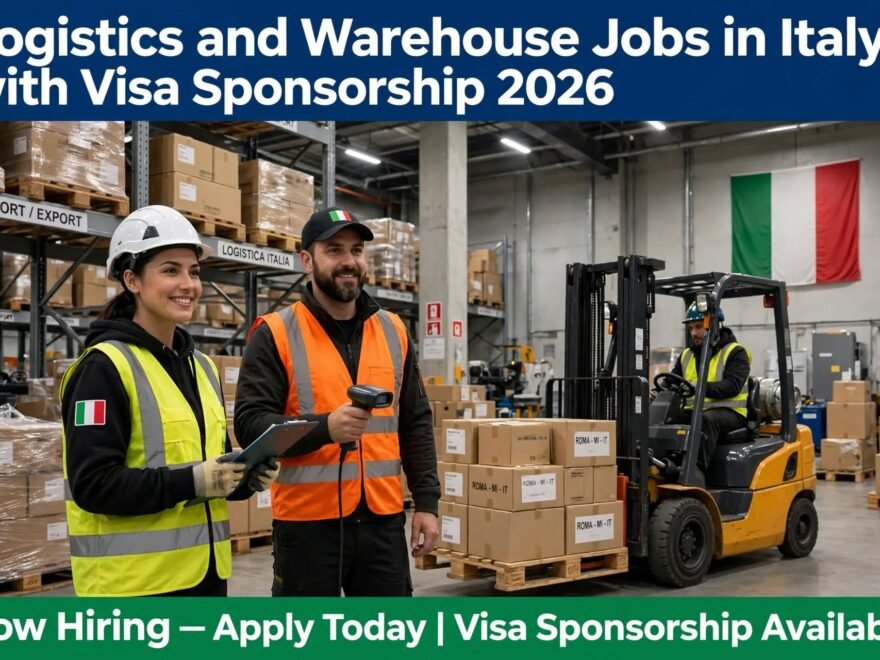
Logistics and Warehouse Jobs in Italy with Visa Sponsorship: If you have ever dreamed of working in Europe, Italy might not be the first country that comes to mind. Yet it should be. Italy sits at the centre of the Mediterranean, connects Northern Europe with the rest of the world through its ports and motorways, and runs one of the busiest freight networks on the continent. Every parcel, pallet and container moving through that network needs people to handle it.
That is where logistics and warehouse jobs in Italy with visa sponsorship come in. Italian employers are struggling to fill positions in storage, picking, packing, forklift driving and distribution, and the government has created legal routes that let non-EU workers fill those gaps.
In this guide, I will walk you through how the system really works: which jobs exist, what they pay, which regions hire the most, how visa sponsorship is organised, and how to protect yourself from the fake job offers that circulate online. No fluff, just what you need to plan your next step.
Why Italy Needs Logistics and Warehouse Workers
Italy is one of Europe’s major manufacturing and export economies. Fashion, food, machinery, automotive parts and pharmaceuticals all leave Italian factories every day, and all of them pass through warehouses and distribution centres first.
Read Also: Chef and Restaurant Jobs in Italy: How to Work in the Italian Food Industry
On top of that, e-commerce has grown rapidly. Online shopping means more fulfilment centres, more returns handling and more last-mile delivery hubs, especially around Milan, Bologna and Rome.
At the same time, Italy has an ageing population and a shrinking local workforce. Many Italian employers openly say they cannot find enough people willing to do shift-based physical work. This labour shortage is the main reason the government keeps opening legal entry routes for foreign workers.
Key Drivers of Demand
- Strategic location: Italy’s ports in Genoa, Trieste, La Spezia and Gioia Tauro handle huge volumes of cargo.
- E-commerce growth: Large fulfilment centres keep opening in the north.
- Strong manufacturing exports: Producers need reliable storage and distribution partners.
- Workforce shortages: Local candidates are not enough to cover night shifts, seasonal peaks and physically demanding roles.
Types of Logistics and Warehouse Jobs Available in Italy
The sector is wider than most people expect. Here are the most common roles you will see advertised.
Warehouse Operator (Magazziniere)
This is the classic entry-level role. You receive goods, check them against delivery notes, store them in the right location and keep the warehouse organised. It is a good starting point if you have no previous experience in Italy.
Order Picker and Packer
Pickers collect items from shelves based on customer orders, often using handheld scanners or voice systems. Packers prepare those items for shipment. These jobs are abundant in e-commerce and retail distribution centres.
Forklift Operator (Carrellista)
Forklift drivers move pallets, load trucks and manage stock in high-bay racking. This role usually pays better than general warehouse work, but it requires a recognised licence (more on this below).
Loader and Unloader
These workers load and unload trucks and containers. The work is physical, and it is common in port areas and freight terminals.
Inventory Clerk and Stock Controller
These roles involve counting, reconciling and recording stock using warehouse management software. Basic computer skills and attention to detail matter more than physical strength here.
Shift Supervisor and Warehouse Team Leader
With experience, you can move into coordination roles. Supervisors manage teams, schedules and safety, and they usually need decent Italian or English plus leadership experience.
Delivery Driver and Last-Mile Courier
Parcel companies and local distributors hire drivers for urban and regional routes. Note that professional driving usually requires an Italian-recognised licence, so check conversion rules before applying.
Understanding Visa Sponsorship for Logistics Jobs in Italy
Let us clear up the most important point first. In Italy, you generally cannot simply fly in on a tourist visa and start working. A non-EU citizen needs an authorisation linked to a real job offer from a real Italian employer. That is what people mean by “visa sponsorship”.
The employer starts the process, not the worker. The worker then completes the visa and residence steps once the authorisation is granted.
The Decreto Flussi Explained
Italy manages most non-EU employment entries through a quota system called the Decreto Flussi (the Flows Decree). It is a government decree that sets how many foreign workers can enter Italy each year for seasonal and non-seasonal work.
The current decree covers 2026 to 2028 and authorises roughly 497,550 entries over the three years, with around 164,850 places for 2026, about 165,850 for 2027 and about 166,850 for 2028. Warehouse and logistics roles normally fall under the non-seasonal employed work category.
Quotas are usually allocated through “click days”, when employers submit applications online and places are granted in order of submission. The 2026 non-seasonal click days took place in February 2026. For the next rounds, watch the Ministry of the Interior and the Ministry of Labour websites, because dates and rules can change from year to year. The authorities have also said they want to reduce reliance on the click-day system and expand routes that sit outside the quotas, so the details may evolve.
Who Can Apply?
- Employers register on the Ministry of the Interior’s online portal and submit the application for a specific worker.
- Workers must be non-EU citizens, abroad at the time of application, and usually need a genuine job offer plus suitable accommodation arranged by the employer.
- Some countries have migration cooperation agreements with Italy, and these can come with separate quotas. It is worth checking whether your country is on the list.
Step-by-Step: How the Visa Sponsorship Process Works
Here is the typical path from job offer to your first day in the warehouse.
- Find an employer willing to sponsor you. This is often the hardest step. Use legitimate job boards, recruitment agencies and company career pages.
- Employer submits the quota application. The employer applies for the work authorisation (nulla osta) through the official online system during the relevant click-day window.
- Local immigration office reviews the file. The Sportello Unico per l’Immigrazione checks the employer’s documents, the contract offer and the availability of a quota place.
- Nulla osta is issued. Once approved, the authorisation is sent to the Italian embassy or consulate in your country.
- Apply for the entry visa. You book an appointment at the consulate, submit your passport and documents, and apply for a national work visa (type D).
- Travel to Italy. After the visa is issued, you can enter Italy.
- Sign the residence contract and apply for a residence permit. Within a short period after arrival (generally eight days), you sign the contratto di soggiorno and apply for the permesso di soggiorno per lavoro subordinato.
- Get your tax code. The codice fiscale is essential for banking, rent and payroll.
Processing times vary by province and consulate, and the full process can take several months from start to finish. Be patient and keep copies of every document.
Documents You Will Typically Need
- Valid passport with sufficient remaining validity
- Signed job offer or contract proposal from the Italian employer
- Copy of the nulla osta
- Proof of accommodation arranged in Italy
- Passport photos and visa application form
- Criminal record certificate and other documents if the consulate requests them
- Proof of relevant work experience or training, where available
Requirements differ between consulates, so always confirm the current list with the Italian embassy that handles your application.
Salary and Working Conditions
Most logistics workers in Italy are covered by a national collective agreement, commonly known as the CCNL Logistica, Trasporto Merci e Spedizione. It sets minimum pay, working hours, overtime rules, holidays and protections.
What Can You Expect to Earn?
Pay depends on the region, the employer, your job level and whether you work nights or weekends. As a rough guide only:
- Entry-level warehouse operators and packers: around €1,300 to €1,600 gross per month
- Experienced forklift operators: often €1,500 to €1,900 gross per month
- Team leaders and supervisors: €1,900 to €2,500 or more gross per month
These are approximations, not guarantees. Always check the contract level and the actual figures. Italian employment typically includes 13th and sometimes 14th month payments, paid leave, sickness cover and contributions to the national pension and health systems.
Hours and Shifts
A standard full-time contract is around 40 hours per week. Many warehouses run two or three shifts, including nights and weekends, which usually come with extra pay. Peak periods such as Black Friday and Christmas can bring overtime.
Best Regions and Cities for Warehouse and Logistics Jobs
Not every part of Italy offers the same number of opportunities. The strongest logistics clusters are in the north and along main transport corridors.
- Lombardy (Milan, Bergamo, Brescia): Italy’s largest logistics hub, with big distribution parks and e-commerce centres.
- Emilia-Romagna (Bologna, Parma, Piacenza): A powerhouse for warehousing, food distribution and parcel hubs.
- Veneto (Verona, Padua): Verona’s freight village is one of the key intermodal hubs in Europe.
- Piedmont (Turin, Novara): Automotive and industrial logistics.
- Lazio (Rome, Pomezia, Frosinone): Distribution for the capital and central Italy.
- Campania (Naples, Nola): Growing logistics base in the south, plus port-related work.
- Liguria and Friuli-Venezia Giulia (Genoa, Trieste): Port and container terminal jobs.
Smaller towns around these hubs often have cheaper housing, which matters when you are working on an entry-level salary.
Skills and Qualifications That Make You Stand Out
You do not need a university degree for most warehouse jobs, but the right skills improve your chances significantly.
Essential Skills
- Physical fitness and comfort with standing, lifting and repetitive tasks
- Attention to detail for picking accuracy and stock counts
- Reliability and punctuality, which Italian employers value highly
- Basic Italian or English for safety instructions and teamwork
Valuable Extras
- Forklift licence (patentino per carrello elevatore): In Italy, operating forklifts requires specific certified training under national safety rules. Many employers pay for it, but arriving with a recognised certificate is a real advantage.
- Warehouse management system (WMS) experience with scanners or inventory software
- Workplace safety training and first-aid awareness
- Previous experience in warehouses, ports, retail distribution or manufacturing
- Italian language skills at A2 or B1 level, which open doors to supervisory roles
How to Find Legitimate Employers Offering Sponsorship
Genuine opportunities exist, but you have to search smartly.
Where to Look
- Company career pages of logistics operators, parcel carriers and retail distributors operating in Italy
- Licensed employment agencies (agenzie per il lavoro): Many warehouse hires in Italy go through temporary staffing agencies that are authorised by the Ministry of Labour
- Professional networks such as LinkedIn, where you can follow logistics firms and message recruiters
- Italian job portals and regional employment centres
- Official government channels for information on quotas and procedures
Tips to Improve Your Chances
- Prepare an Italian-style CV with a clear photo, work history and contact details, plus a short cover letter.
- Mention that you understand the Decreto Flussi process. Employers are more comfortable hiring candidates who know how it works.
- Be flexible about location and shifts.
- Start learning Italian early, even a few basic phrases.
- Apply to many employers, because sponsorship depends on quota timing and each company’s willingness to handle the paperwork.
Beware of Scams: Red Flags to Watch For
Unfortunately, the popularity of “visa sponsorship” has attracted fraudsters. Protect your money and your identity.
Warning signs include:
- Anyone asking you to pay a fee for a guaranteed job or visa
- Job offers that arrive with no interview and unrealistic salaries
- Recruiters who use only free email addresses or messaging apps
- Requests for payment through gift cards, crypto or money transfer services
- Employers who cannot show a registered Italian company or a verifiable address
- Promises that you can “skip the quota” or “buy a click-day place”
Remember: the visa process is initiated and paid for through official channels, and a legitimate Italian employer will not demand money from you in exchange for the nulla osta. If something feels wrong, verify the company in the Italian business register and contact the embassy before sending any documents or money.
Life in Italy as a Warehouse Worker
Working in Italy is not just about the job. It is also about building a life.
Cost of Living
Rent in Milan and Rome is high, while smaller cities and towns near logistics hubs are considerably cheaper. Many workers share apartments in the beginning. Food, public transport and healthcare are generally affordable compared with many other Western European countries.
Healthcare and Social Protection
Once you hold a valid residence permit for employment, you can register with the national health service (Servizio Sanitario Nazionale). Your employer also contributes to your pension and social insurance.
Career Growth
Starting as a picker or loader does not mean staying there forever. With experience, a forklift licence and better Italian, you can grow into team leader, inventory manager or transport planner positions. After several years of legal residence, you may also become eligible for a long-term residence permit.
Common Mistakes to Avoid
- Arriving on a tourist visa hoping to find work. This can cause serious legal problems and make future applications harder.
- Ignoring click-day timing. Quota places can run out quickly, so your employer must be prepared.
- Accepting vague contracts. Always ask for the contract level, hours, salary and duration in writing.
- Paying intermediaries. No legitimate shortcut exists.
- Skipping the language. Even basic Italian makes daily life and work much easier.
Conclusion
Logistics and warehouse jobs in Italy with visa sponsorship are real, legal and increasingly in demand, but they reward people who prepare carefully. The system is built around the Decreto Flussi, so timing, documentation and a genuine employer matter more than anything else. Build your skills, get a forklift certificate if you can, learn some Italian, approach licensed agencies and trusted employers, and stay alert to scams.
If you stay patient and follow the official process step by step, a stable job in Italy’s powerful logistics sector can be the starting point for a long-term career in Europe.
Frequently Asked Questions (FAQ)
1. Can I get a warehouse job in Italy with visa sponsorship without experience?
Yes, entry-level roles such as order picker, packer and warehouse operator often do not require prior experience. However, employers usually prefer candidates with some physical work history or basic training.
2. Do I need to speak Italian?
Not always at the start, but basic Italian or English is very helpful for safety instructions and teamwork. Better language skills improve your chances of promotion.
3. Who pays for the visa sponsorship?
The employer handles the quota application and its related costs. Workers generally pay personal visa and residence permit fees. Never pay anyone for a “guaranteed” job.
4. How long does the process take?
It varies widely. From the employer’s application to your arrival, expect several months, depending on the province, consulate and the quota round.
5. Can I bring my family?
After holding a valid residence permit and meeting income and housing conditions, you may apply for family reunification. Check the current requirements with the Italian immigration authorities.
6. Is a forklift licence mandatory?
If your job involves driving a forklift, yes, you must have the proper certified training. Many employers organise it, but having it beforehand is a big plus.
7. Where can I verify current rules and quotas?
Use official sources such as the Italian Ministry of the Interior, the Ministry of Labour, and the website of the Italian embassy in your country. Immigration rules can change, so always confirm the latest information.
Disclaimer: This article is for general information only and is not legal or immigration advice. Quotas, dates and requirements change, so verify details with official Italian authorities or a qualified immigration professional.
One comment