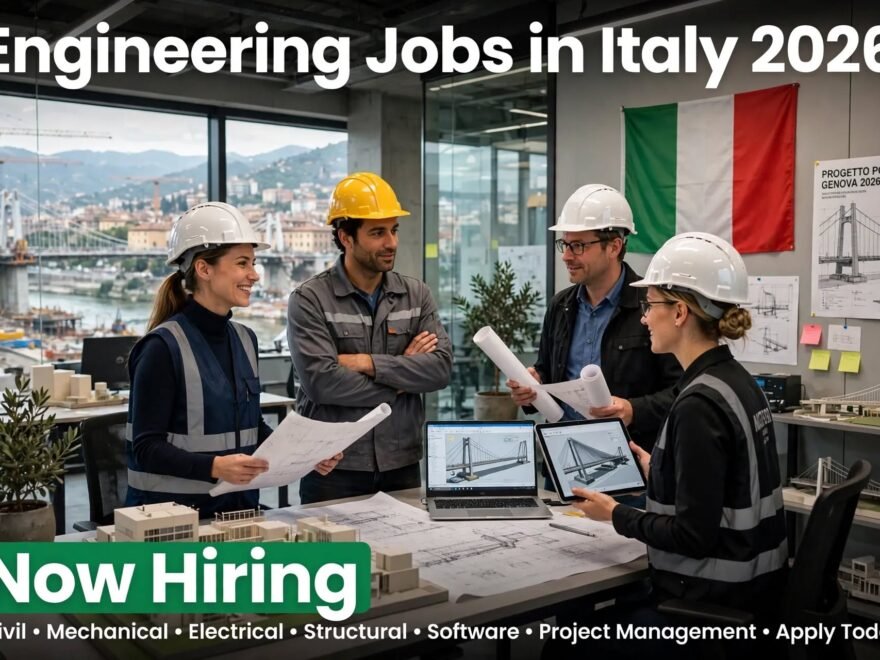
Italy is famous for fashion, food and art, but its real economic engine is engineering. The country is Europe’s second-largest manufacturing power after Germany. It builds supercars, packaging machines, industrial robots, ships, turbines and an ever-growing number of solar and wind plants. Behind every one of those products is an engineer.
If you are a mechanical, automation, electrical or energy engineer thinking about working abroad, engineering jobs in Italy deserve a serious look. Demand for technical talent is strong, many companies are family-owned world leaders hungry for skilled people, and the green transition is creating entirely new career paths.
This guide explains where the opportunities are, what you can expect to earn, which skills employers want, and how foreign engineers can actually get hired. Salary figures are approximate ranges, so always check current job listings and official government sources before making decisions.
Read Also: Logistics and Warehouse Jobs in Italy with Visa Sponsorship: A Complete 2026 Guide
Why Italy Is a Smart Choice for Engineers
Before going deeper, here is why so many engineers are looking at Italy.
- A deep industrial base. Thousands of small and medium-sized manufacturers, many of them global leaders in niche markets, need engineers who can design, automate and improve production.
- Strong export culture. Italian machinery, automotive components and industrial equipment are sold worldwide, which keeps engineering teams busy.
- Green investment. National and European recovery funds are pushing money into renewable energy, grid upgrades and energy efficiency.
- Quality of life. Good healthcare, excellent food, mild weather in many regions and easy travel across Europe make daily life attractive.
- Skills shortage. Employers regularly report difficulty finding enough technical graduates and experienced engineers, which opens the door to international candidates.
The Italian Engineering Job Market at a Glance
Italy’s industry is not concentrated in one city. It is spread across clusters, and knowing them helps you target your job search.
Northern Italy: The Industrial Heartland
The north, especially Lombardy, Piedmont, Veneto and Emilia-Romagna, hosts most of the country’s manufacturing. Milan is the corporate and engineering consulting hub, Turin is the traditional home of automotive and aerospace, and Bologna and its surroundings are known for packaging machinery and mechatronics.
Central Italy
Tuscany, Lazio and Marche offer opportunities in energy, oil and gas services, aerospace components, appliances and infrastructure. Rome is where many public-sector energy and infrastructure projects are managed.
Southern Italy and the Islands
Puglia, Sicily and Sardinia are the main centres for solar and wind development, thanks to strong sunshine and wind resources. Naples and Campania also have aerospace and rail industries.
Mechanical Engineering Jobs in Italy
Mechanical engineering is the backbone of Italian industry and probably the largest category of engineering jobs in the country.
Where Mechanical Engineers Work
- Automotive and motorsport: The Emilia-Romagna region, often called Motor Valley, is home to legendary sports car and motorcycle makers, plus hundreds of suppliers working on engines, chassis, transmissions and lightweight materials.
- Industrial machinery: Italy is a global leader in packaging, food-processing, woodworking, ceramics and machine-tool equipment.
- Aerospace and defence: Large groups and their supply chains hire design, stress-analysis and testing engineers.
- Shipbuilding and marine: Italian yards are respected for cruise ships and luxury yachts, requiring naval and mechanical specialists.
- HVAC, pumps and valves: A strong niche for engineers interested in fluid systems and energy efficiency.
Typical Job Titles
- Mechanical Design Engineer
- R&D Engineer
- Maintenance and Reliability Engineer
- Production or Process Engineer
- Quality Engineer
- Project or Technical Sales Engineer
Skills Employers Look For
- Proficiency in CAD tools such as SolidWorks, CATIA, Creo or Siemens NX
- Knowledge of FEA and CFD simulation
- Understanding of GD&T, materials and manufacturing processes
- Familiarity with lean manufacturing and quality standards
- Basic Italian, which many shop-floor teams still use daily
Automation and Robotics Engineering Jobs in Italy
If mechanical engineering is the backbone, automation is the nervous system. Italian manufacturers are investing heavily in smart factories, a trend often described as Industry 4.0, and that has created steady demand for automation talent.
What Automation Engineers Do
Automation engineers design, program and commission the systems that make machines work together. In Italy, that usually means:
- Programming PLCs from brands such as Siemens, Rockwell, Beckhoff and Schneider
- Developing SCADA and HMI interfaces
- Integrating industrial robots and collaborative robots on production lines
- Setting up sensors, vision systems and industrial networks
- Using data from machines for predictive maintenance and efficiency
In-Demand Roles
- Controls Engineer
- Robotics Integration Engineer
- Mechatronics Engineer
- Industrial IoT Specialist
- Commissioning and Field Service Engineer
Commissioning roles often involve travel, because Italian machine builders install equipment in factories around the world. That can be a great way to gain international experience quickly.
Skills That Make You Stand Out
- IEC 61131-3 programming languages
- Experience with motion control and servo drives
- Python or C++ for data and robotics applications
- Knowledge of machine safety standards
- Comfort working in cross-functional teams of mechanical, electrical and software engineers
Renewable Energy Engineering Jobs in Italy
The energy transition is one of the fastest-growing sources of renewable energy jobs in Italy. The country has long been a leader in solar power in Europe, and its long coastline, mountain rivers and windy southern regions give it many options.
Main Renewable Sectors
- Solar photovoltaic: Utility-scale parks, rooftop systems and agrivoltaic projects that combine farming with solar panels.
- Wind energy: Onshore wind farms in the south and growing interest in floating offshore wind.
- Hydropower: A mature sector with ongoing modernisation work in the Alps and Apennines.
- Geothermal: Tuscany has one of the world’s oldest geothermal industries.
- Green hydrogen and storage: Pilot projects, battery systems and grid-balancing solutions are emerging fast.
- Biomass and biogas: Particularly relevant in agricultural regions.
Typical Roles
- Renewable Project Engineer
- Electrical Design Engineer (substations, cabling, protection)
- Grid Integration Specialist
- Energy Storage Engineer
- Construction and Site Manager
- Energy Efficiency Consultant or Energy Manager
- Permitting and Environmental Engineer
Who Hires
Major energy groups, grid operators, independent developers, engineering consultancies and equipment manufacturers all recruit in this field. Many are international companies that work in English, which can make renewables an easier entry point for foreign engineers than traditional manufacturing.
Engineer Salary in Italy: What to Expect
Salaries in Italy are generally lower than in Germany, Switzerland or the Netherlands, but the cost of living is also lower, especially outside Milan. The ranges below are rough yearly gross estimates and vary by company, region and sector.
| Experience level | Approximate gross annual salary |
|---|---|
| Graduate / junior (0–2 years) | €27,000 – €33,000 |
| Mid-level (3–7 years) | €35,000 – €50,000 |
| Senior / team lead (8+ years) | €50,000 – €75,000 |
| Engineering manager / director | €75,000 and above |
Factors That Influence Pay
- Location: Milan and the big northern hubs pay more, but rent is higher too.
- Industry: Automotive, energy and specialised machinery often pay above average.
- Company size and ownership: Multinationals frequently offer better packages than small family firms, though smaller firms may provide faster growth.
- Language skills: Fluent Italian combined with strong technical skills can raise your negotiating power.
- Benefits: Many contracts include a 13th-month salary, meal vouchers, company welfare plans and generous paid leave.
Tax and social contributions are significant in Italy, so always compare net pay, not only gross figures.
Work Visa and Permit Options for Foreign Engineers
Your route depends on where you come from.
EU and EEA Citizens
You can live and work in Italy without a visa. You will need to register your residence and obtain a tax code (codice fiscale) after arriving.
Non-EU Engineers
Most non-EU engineers need a job offer before they can apply for a visa. The main routes are:
- Subordinate work visa (lavoro subordinato): Usually tied to the annual entry quotas known as the Decreto Flussi. The employer starts the process through the Italian authorities.
- EU Blue Card: Designed for highly qualified workers with a university degree and a job offer that meets a minimum salary threshold, which is updated periodically. It can offer more flexibility and a path to long-term residence.
- Intra-company transfer: For employees moved to an Italian branch of the same multinational.
- Student-to-work conversion: If you study engineering in Italy, you can often convert your permit to a work permit after graduation.
- Job-seeker options: Some pathways may allow qualified graduates to look for work, but rules change, so check official sources.
Important: Visa rules, quotas and salary thresholds change regularly. Always confirm details with the Italian embassy, the Ministry of Foreign Affairs or the Ministry of Interior before applying, and be cautious of anyone who asks for money in exchange for a guaranteed job or visa.
Degree Recognition and Professional Registration
A common question is whether your foreign engineering degree will be accepted.
- For most private-sector jobs, employers care mainly about your skills, experience and the reputation of your university. Having your degree officially recognised or verified helps, especially for visas.
- Italian bodies such as CIMEA provide degree evaluation and comparability services.
- To sign off on certain projects, such as structural or public works, you may need to pass the state exam and register with the Ordine degli Ingegneri (Order of Engineers). Many employees working in industry do not need this, but it matters for consulting and some design roles.
- Keep certified translations of your transcripts and diploma ready. Missing paperwork is one of the most common causes of delays.
Do You Need to Speak Italian?
The honest answer is: it depends.
- Multinationals, energy developers and R&D teams often work in English, particularly in Milan, Turin and Bologna.
- Small and mid-sized manufacturers usually expect at least basic to intermediate Italian, because production staff and suppliers speak it.
- Daily life is much easier with Italian. Dealing with landlords, banks and local offices is smoother when you can communicate.
A realistic goal is to reach B1 level within your first year. Even if your job is in English, employers notice and appreciate the effort.
How to Find Engineering Jobs in Italy
A focused strategy works better than mass-applying. Here is a step-by-step approach.
Step 1: Build an Italy-Ready CV
- Keep it to one or two pages in a clean European format
- Highlight specific tools, software and project results with numbers
- Include language levels and certifications
- Add a short, tailored cover letter for every application
Step 2: Use the Right Platforms
- LinkedIn: Essential for multinationals and recruiters. Optimise your profile with keywords such as “mechanical design” or “PLC programming”.
- Italian job boards: InfoJobs, Indeed Italia, Jobrapido and Monster Italia list a wide range of technical roles.
- Company career pages: Many Italian manufacturers post vacancies only on their own websites.
- Specialist recruiters: Engineering and technical staffing agencies can match you with employers who sponsor foreign talent.
- EURES: The European job mobility portal can be useful for EU candidates.
Step 3: Target Industry Clusters
Pick two or three regions and research the companies there. A targeted email to an engineering manager at a machine builder can sometimes work better than a generic online application.
Step 4: Prepare for Interviews
Expect technical questions, a discussion of your past projects and, in some firms, a practical test or case study. Be ready to explain why Italy and how long you plan to stay. Italian employers value commitment and cultural fit.
Step 5: Consider a Master’s or PhD in Italy
Italian polytechnic universities, particularly those in Milan and Turin, have strong industry links. Studying there can give you internships, networking and a smoother route to employment.
Skills and Certifications That Boost Your Chances
- Technical: CAD/CAM, simulation, PLC and SCADA, robotics, power systems, energy modelling
- Digital: Python, MATLAB, data analysis, digital twins
- Project management: PMP, PRINCE2 or agile experience
- Quality and safety: Six Sigma, ISO standards, machine safety knowledge
- Sustainability: Energy management certifications and life-cycle assessment knowledge
- Soft skills: Clear communication, adaptability and teamwork across cultures
Career Growth and Long-Term Prospects
Engineering careers in Italy can progress in several directions.
- Technical specialist: Become the go-to expert in a field such as motion control, thermal systems or grid protection.
- Management: Move into project, plant or department leadership.
- Consulting or entrepreneurship: Italy has a strong tradition of small technical firms started by former employees.
- International roles: Experience with Italian manufacturers is respected across Europe and beyond.
After several years of legal residence, you may also qualify for long-term residence status, which brings greater stability for you and your family.
Challenges to Be Aware Of
No country is perfect, and it helps to go in with realistic expectations.
- Bureaucracy can be slow and paperwork-heavy.
- Salaries may be lower than in other Western European countries.
- Regional differences are large, with more opportunities in the north than the south.
- Language can be a barrier in smaller companies.
- Hiring processes may take longer than you expect.
Patience, organisation and a willingness to adapt will make the biggest difference.
Conclusion
Italy offers a rare mix of world-class manufacturing, growing clean-energy investment and an enviable lifestyle. Whether you want to design high-performance machines, program the robots that build them or develop the solar and wind farms powering the future, engineering jobs in Italy provide room to grow.
The best approach is to pick a specialty, target the right region, polish your CV, learn some Italian and understand the visa route that fits your situation. Start small, stay consistent, and use only official channels for visa and permit information.
Frequently Asked Questions (FAQ)
1. Are engineers in demand in Italy?
Yes. Many employers report shortages in mechanical, electrical, automation and energy-related roles, especially in the industrial north.
2. How much does an engineer earn in Italy?
Typical gross salaries range from roughly €27,000 for juniors to €75,000 or more for senior professionals, depending on sector, location and experience.
3. Can a foreign engineer get a work visa in Italy?
Yes, usually with a job offer from an Italian employer. Routes include the standard work visa under annual quotas and the EU Blue Card for highly qualified workers. Always verify current rules with official sources.
4. Do I need to speak Italian to work as an engineer in Italy?
Not always. Multinationals and renewable energy companies often use English, but Italian is very helpful and often expected in smaller firms.
5. Which Italian cities are best for engineering jobs?
Milan, Turin, Bologna, Modena, Padua and Brescia are among the strongest hubs, while southern regions are important for solar and wind projects.
6. Is renewable energy a good career path in Italy?
It is a promising one. Solar, wind, storage and grid modernisation continue to expand, creating roles in design, construction, operations and consulting.
7. Will my foreign engineering degree be recognised?
Most private employers focus on skills and experience, but official recognition or evaluation can help with visas and certain regulated activities. Some roles require registration with the Order of Engineers.
8. Can I move to Italy as a student and stay to work?
Often yes. Many international graduates of Italian universities convert their study permits into work permits once they find a qualifying job.
One comment