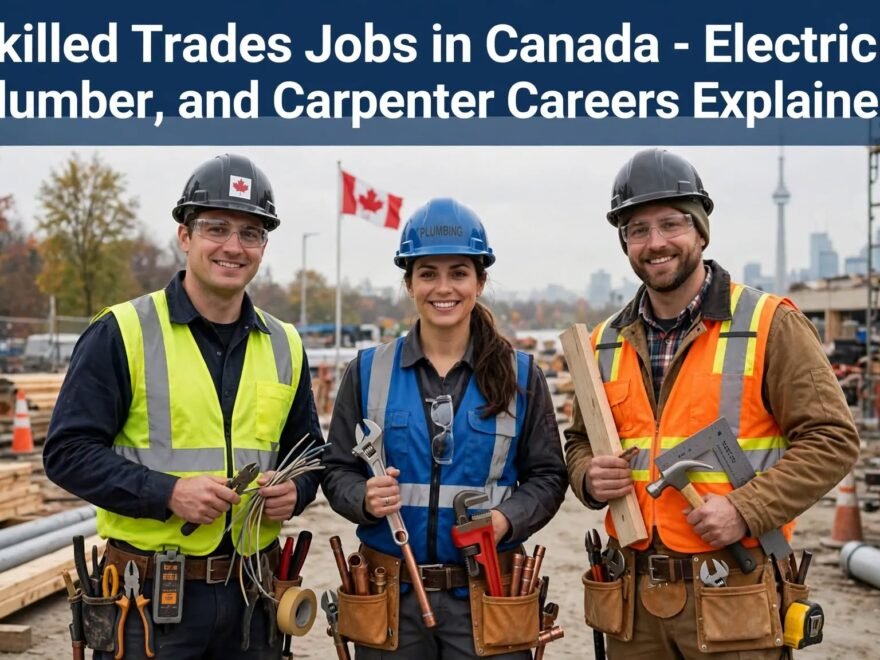
Not every strong career begins in a university lecture hall. Across Canada, thousands of people are building stable, well-paid futures with their hands, their tools, and a good apprenticeship. Homes need wiring, pipes need installing, and frames need raising. As experienced workers retire, employers are looking hard for new talent.
Skilled trades jobs in Canada offer something many office careers can’t: you get paid while you learn, you avoid heavy student debt, and your skills stay in demand. Three trades stand out for beginners, career changers, and newcomers: electrician, plumber, and carpenter.
This guide covers what each trade involves, how training works, what you can expect to earn, and how internationally trained workers can use Canada’s immigration system. Whether you’re a student, a mid-career switcher, or planning a move to Canada, you’ll find a clear starting point here.
Why Skilled Trades Are in Demand in Canada
Canada’s construction and maintenance sectors need workers steadily. Several forces keep demand high:
- An ageing workforce: Many experienced tradespeople are nearing retirement.
- Housing and infrastructure needs: New homes, transit projects, and renovations all require skilled labour.
- Energy transition: Electric vehicle chargers, solar installations, and building upgrades create new work, especially for electricians.
- Regulation and safety: Electrical and plumbing work must meet strict codes, so qualified professionals can’t easily be replaced.
Read Also: Warehouse Worker Jobs in Canada: Pay, Shifts, and Top Employers Hiring Now
Canada’s government also recognises this. In February 2026, the federal immigration department announced Express Entry categories that include trades such as carpenters, plumbers and machinists. That is a strong signal about where the labour market is heading. canada
How Skilled Trades Careers Work in Canada
Before looking at each trade, it helps to understand the basic structure.
The Apprenticeship Model
Most trades follow the same path:
- Find an employer (sponsor) who agrees to train you.
- Register as an apprentice with your province or territory’s apprenticeship authority.
- Work on the job and log your hours under a certified journeyperson.
- Attend technical training, usually a few weeks each year at a college or training centre.
- Pass your certification exam to become a certified journeyperson.
Roughly 80% or more of your training happens on the job, and you earn a wage the whole time. Wages typically rise as you complete each level.
What Is the Red Seal?
The Red Seal Program is a national standard. A trade with Red Seal endorsement lets you work in other provinces and territories without retraining. Electrician (construction), plumber, and carpenter are all Red Seal trades. For a worker who may relocate, that mobility is a big advantage.
Provincial Rules Differ
Each province and territory runs its own apprenticeship system. Requirements, hour totals, and whether a trade is compulsory (you must be certified to work in it) or voluntary vary by location. Always check your provincial apprenticeship authority before you start.
Electrician Careers in Canada
What Does an Electrician Do?
Electricians install, maintain, and repair electrical systems. Construction and maintenance electricians work on:
- Wiring in homes, offices, and factories
- Lighting, panels, and circuit systems
- Fire alarms and security systems
- Solar panels and EV charging stations
- Troubleshooting faults and upgrading older systems
Training and Certification
Becoming a construction electrician usually takes about four to five years, including thousands of on-the-job hours and several levels of classroom training. Because electrical work carries real safety risks, most provinces treat it as a compulsory trade.
Typical entry requirements:
- High school diploma or equivalent (often with maths and science)
- Strong problem-solving and attention to detail
- Willingness to work at heights and in tight spaces
- Physical fitness and a good safety mindset
Electrician Salary in Canada
According to Job Bank wage data, electricians in Canada earn a median of about $35 per hour, with the range running from roughly $20 at the low end to $48 at the high end. Wages vary by region. Provinces such as Alberta and Quebec report higher medians than the Atlantic provinces. Also, around 87% of electricians receive at least one type of non-wage benefit, such as health coverage or pension plans. jobbankjobbank
Career Growth for Electricians
- Industrial electrician: work in factories and power plants
- Inspector or estimator: move off the tools into office-based roles
- Contractor: run your own electrical business
- Specialist: focus on renewable energy, automation, or data centres
Plumber Careers in Canada
What Does a Plumber Do?
Plumbers do far more than fix leaky taps. They design, install, and maintain systems that carry water, gas, and waste. Common tasks include:
- Installing pipes, fixtures, and water heaters
- Reading blueprints and building plans
- Setting up drainage and sewage systems
- Repairing leaks and clogged lines
- Working with heating and gas-fitting systems (in some provinces)
Training and Certification
The plumber apprenticeship generally runs about four to five years and combines on-the-job hours with technical training. Like electricians, plumbers are regulated in most provinces because poor plumbing can harm public health.
Skills that help:
- Mechanical aptitude and physical stamina
- Basic maths for measuring and pipe calculations
- Good customer service, since you’ll often work in people’s homes
- Calm problem-solving during emergencies
Plumber Salary in Canada
Job Bank reports that maintenance plumbers in Canada earn a median of about $34 per hour, ranging from around $21 to $46. Emergency call-outs, overtime, and self-employment can raise total income further. jobbank
Career Growth for Plumbers
- Gasfitter or steamfitter: add related certifications
- Service technician: specialise in residential repair
- Project supervisor: manage crews on large builds
- Business owner: start a plumbing company
Plumbing also offers strong job security. People will always need running water, heat, and working drains, whatever the state of the economy.
Carpenter Careers in Canada
What Does a Carpenter Do?
Carpenters build and repair structures made of wood and other materials. The trade is broad, and many carpenters specialise:
- Framing carpenters build the skeleton of houses and buildings
- Finish carpenters install trim, cabinetry, and stairs
- Formwork carpenters create moulds for concrete structures
- Renovation carpenters upgrade and restore existing homes
Training and Certification
A carpenter apprenticeship usually takes about four years, though exact hours depend on the province. In some regions the trade is voluntary, meaning you can work without certification. Even so, becoming a certified journeyperson boosts your pay, credibility, and career options. It also gives you Red Seal mobility.
Helpful traits:
- Good spatial thinking and measurement skills
- Physical strength and endurance
- Creativity and precision
- Comfort working outdoors in all seasons
Carpenter Salary in Canada
Job Bank figures show that carpenters in Canada earn a median of around $32 per hour, with typical wages ranging from about $22 to $44. Western provinces and the territories often pay more, reflecting higher living costs and project demand. About 82% of carpenters report receiving some type of non-wage benefit. jobbankjobbank
Career Growth for Carpenters
- Site foreman or superintendent
- Cabinetmaker or millwork specialist
- Building inspector
- General contractor or home builder
Electrician vs. Plumber vs. Carpenter: Quick Comparison
| Factor | Electrician | Plumber | Carpenter |
|---|---|---|---|
| Median hourly wage (Canada) | About $35 | About $34 | About $32 |
| Typical apprenticeship | 4–5 years | 4–5 years | About 4 years |
| Regulation level | Usually compulsory | Usually compulsory | Often voluntary |
| Work environment | Indoors and outdoors, often technical | Homes and commercial sites | Mostly construction sites |
| Best for people who like | Technology and problem-solving | Mechanics and hands-on repair | Building and creative craftsmanship |
Figures are approximate and based on Job Bank national medians. Your local rate may differ.
How to Start a Skilled Trades Career in Canada
If you live in Canada, here is a practical path:
- Pick a trade that suits your strengths and interests. Try job shadowing if you can.
- Check your province’s rules on the apprenticeship authority’s website.
- Finish the prerequisites, which often means high school maths and English.
- Consider pre-apprenticeship or foundation programs. These short college courses can make you a more attractive hire.
- Apply to employers, unions, and contractors who sponsor apprentices.
- Register and log your hours carefully.
- Study for and pass your exam to earn journeyperson status.
Tip: Networking matters. Many apprenticeships come through union halls, trade associations, and word of mouth, not just job boards.
Skilled Trades Immigration: Moving to Canada as a Tradesperson
Canada actively welcomes qualified tradespeople. If you’re abroad, these are the main routes.
Express Entry and the Trades Category
Express Entry manages applications through the Federal Skilled Worker Program, the Federal Skilled Trades Program, and the Canadian Experience Class. Beyond the general draws, IRCC runs category-based draws, and the trades category continues in 2026. In April 2026, IRCC held a draw targeting trade occupations, the first trades draw of 2026. immigrationnewscanada
For this category, candidates outside Canada with 12 months of eligible trade experience in the past three years and a valid Express Entry profile can receive invitations. Note too that the category now focuses almost entirely on construction, industrial, and mechanical trades rather than food service occupations. immigrationnewscanadaimmigrationnewscanada
Federal Skilled Trades Program (FSTP)
This program is designed for experienced workers in eligible trades. In general, you’ll need:
- Qualifying work experience in your trade
- Sufficient English or French language ability
- A valid job offer or a certificate of qualification from a Canadian province or territory
- Meeting the job requirements for your occupation
Provincial Nominee Programs (PNPs)
Many provinces run streams for tradespeople in shortage occupations. These can be a strong option if your Express Entry score is modest but a province needs your skills.
Important Tips for Newcomers
- Get your credentials assessed. Provinces decide how your foreign experience counts toward certification.
- Improve your language scores. Strong English or French results lift both your immigration chances and your job prospects.
- Understand TEER levels. Skilled trades are generally classified at TEER 2 or 3, which matters for Express Entry eligibility.
- Use official sources. Rules change. Check IRCC and your provincial authority, and be cautious of anyone guaranteeing results.
Pros and Cons of Skilled Trades Careers
Advantages
- Earn while you learn with minimal or no student debt
- High demand and strong job security
- Good wages and benefits, as the Job Bank figures above show
- Entrepreneurial potential, since many tradespeople eventually run their own businesses
- Portable skills thanks to the Red Seal
- Visible results, because you see what you’ve built or fixed
Challenges
- Physical demands can take a toll over decades
- Weather and seasonal slowdowns may affect some construction work
- Early-stage wages are lower while you’re an apprentice
- Safety risks require constant vigilance and proper training
- Finding a sponsor can be competitive in some regions
Being honest about these trade-offs helps you decide with open eyes.
Tips to Succeed in Your Trade
- Show up early and reliable. Employers consistently say dependability gets apprentices noticed.
- Ask questions. Journeypeople respect apprentices who want to learn properly.
- Invest in good boots, tools, and safety gear.
- Keep learning. Codes and technology evolve, especially in electrical and plumbing work.
- Build a reputation. In the trades, word of mouth often leads to your next job.
- Plan your finances. Consider the grants and tax credits available to apprentices through federal and provincial programs.
Conclusion
Skilled trades jobs in Canada combine practical work, strong earning potential, and real stability. Electricians power the country’s homes and industries. Plumbers protect public health and comfort. Carpenters build the spaces where Canadians live and work. Each trade offers a clear route from apprentice to journeyperson to possible business owner.
For newcomers, Canada’s trades-focused immigration options add another reason to look seriously at this field. If you’re willing to train, work hard, and keep learning, a trade can be one of the most rewarding career choices available.
More also:Warehouse Supervisor Jobs in Canada
Your next step: research your province’s apprenticeship authority, speak with local employers or training colleges, and choose the trade that fits you best.
Frequently Asked Questions (FAQs)
1. Which trade pays the most: electrician, plumber, or carpenter?
Based on Job Bank medians, electricians earn slightly more on average, followed closely by plumbers, then carpenters. Actual income depends on your province, experience, overtime, and whether you’re self-employed.
2. How long does it take to become a certified tradesperson?
Most apprenticeships take about four to five years, combining paid work with technical training. The exact length depends on the trade and the province.
3. Do I need a university degree for skilled trades?
No. Most trades require a high school diploma or equivalent, plus a registered apprenticeship. Some people also complete a college pre-apprenticeship program first.
4. Can I work in a different province after certifying?
Yes, if your trade has Red Seal endorsement. Electrician (construction), plumber, and carpenter are all Red Seal trades.
5. Can foreign-trained electricians, plumbers, and carpenters immigrate to Canada?
Yes. Options include Express Entry (including the trades category), the Federal Skilled Trades Program, and provincial nominee streams. Requirements on experience, language, and certification apply, so check official government sources.
6. Is it too late to start a trade in my 30s or 40s?
Not at all. Many people change careers into the trades later in life. Employers value maturity and reliability, though you should consider the physical demands.
7. Is the work physically hard?
It can be. Carpentry tends to be the most physically demanding day to day, but all three trades involve standing, lifting, and working in varied conditions. Many experienced workers move into supervising, estimating, or inspection later.
Disclaimer: Wages, apprenticeship rules, and immigration criteria change. Confirm details with Job Bank, IRCC, and your provincial apprenticeship authority before making career or immigration decisions.
One comment