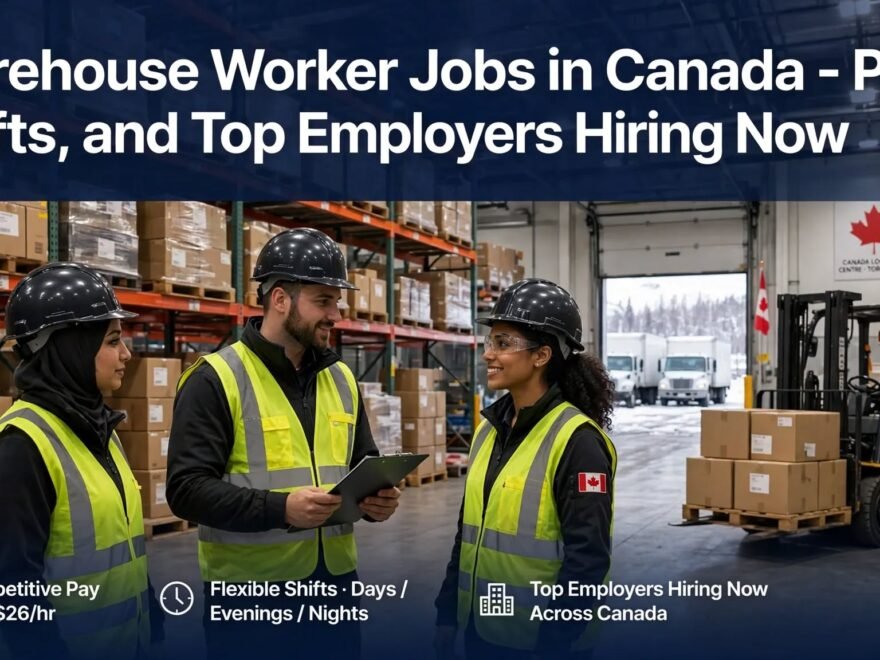
Every parcel that lands on a Canadian doorstep passes through a warehouse first. Online shopping, grocery distribution and cross-border trade all depend on people who pick, pack, scan, sort and load goods. That is why warehouse worker jobs in Canada remain one of the most accessible entry points into the labor market, for students, career-changers and newcomers alike.
These jobs aren’t glamorous, but they are steady, they usually don’t demand a degree, and many employers offer benefits, overtime and a path to supervisory roles. This guide covers what the work involves, what you can realistically earn right now, which shifts to expect, who is hiring this season, and how to avoid the scams that target job seekers. If you’re deciding whether this career is for you, read on.
What Does a Warehouse Worker Actually Do?
“Warehouse worker” is an umbrella title. Your daily tasks depend on the facility and the role. Common positions include:
- Warehouse associate / general labourer: unloading trucks, moving stock, keeping aisles organised
- Order picker: collecting items from shelves based on a scanner or pick list
- Packer: boxing and labelling orders, checking quality
- Sortation worker: scanning parcels and routing them to the correct conveyor or cage
- Inventory control associate: counting stock, resolving discrepancies in the system
- Forklift / reach-truck operator: moving pallets using powered equipment
- Shipping and receiving clerk: checking paperwork, documenting incoming and outgoing freight
Most entry-level roles involve standing for long periods, lifting (often up to 23 kg or more), and working to productivity targets. If you like active, structured work rather than a desk, it can suit you well.
Read Also: Customer Service Representative Jobs in Canada: Salaries, Requirements, and How to Apply
How Much Do Warehouse Workers Earn in Canada?
Pay depends on province, employer, shift and whether the site is unionized. Here is a realistic picture.
The legal floor: minimum wage by province
No employer can pay less than the provincial minimum wage. Several rates changed this fall:
- Ontario: $17.95 per hour as of October 1, 2026 cp24
- British Columbia: $18.25 per hour since June 1, 2026 jdsupra
- Manitoba: $16.40 cp24
- Nova Scotia: $17.00 cp24
- Saskatchewan: $15.70 cp24
- Prince Edward Island: $17.30 cp24
- Quebec: $16.60 per hour since May 1, 2026 jdsupra
- Alberta: $15.00, currently the lowest in the country cp24
- Federally regulated employers: $18.15 since April 1, 2026 jdsupra
What warehouse jobs actually pay
Actual wages usually sit above minimum wage, especially at large employers. Salary-survey sites give broad ranges. Payscale, for example, puts the early-career average around C$17.68 per hour, with most workers between roughly C$15 and C$23. For mid-career workers, the same source shows an average near C$19.88, with the top end reaching about C$26. Treat survey figures as a rough guide, because they often lag behind big-employer wage hikes. payscalepayscale
Large e-commerce employers pay more. Amazon says its seasonal roles this holiday season average nearly $24 per hour in base pay, and permanent staff average more than $26. Individual postings vary by location. A recent Hamilton, Ontario listing showed $22.10 to $22.60 per hour, while a seasonal part-time role in Richmond, B.C. listed $18.75 to $20.75. 9,000: Amazon boosting hires for holiday season in Canada +2
Ways to earn more
- Get forklift certified. Operators generally earn a few dollars more per hour than general labourers.
- Work nights or weekends. Many employers add a shift premium.
- Take overtime. In Ontario, for example, overtime pay applies after 44 hours a week. Rules differ by province.
- Learn inventory systems. Payscale data shows workers with inventory control skills average about C$18.79 per hour, with higher earners reaching the mid-C$20s. payscale
- Move into lead hand or supervisor roles. These come with a clear pay step.
Typical Shifts and Schedules
Warehouses often run around the clock, so you’ll usually find a shift that fits your life. Common patterns include:
- Day shift: roughly 7 a.m. to 3:30 p.m., the most popular and the most competitive
- Evening shift: often 3 p.m. to midnight, common in distribution centres
- Overnight shift: typically 10 p.m. to 6 a.m., usually with a pay premium
- Weekend-only shifts: longer days (10 to 12 hours) with fewer working days, popular with students
- Compressed schedules: for example four 10-hour days, found at some large fulfilment centres
Amazon’s own postings show how flexible scheduling can be. One recent listing offered overnight, early morning, day, evening and weekend shifts. amazon
Peak season matters. From October to January, e-commerce volume surges, so employers add staff, extend hours and offer more overtime. If you want to get your foot in the door, this is the best window.
Top Employers Hiring Warehouse Workers Now
Openings change weekly, so always confirm on the employer’s official site. These are the names that consistently hire at scale.
Amazon Canada
Amazon is the headline name this season. On October 20, the company announced 9,000 seasonal jobs across 55 sites in Canada, covering fulfilment centres, sortation centres and delivery stations. The roles include select benefits from day one, and Amazon says seasonal work can lead to permanent roles, though permanent positions aren’t guaranteed. Applications go through hiring.amazon.ca, and new postings keep appearing through the holiday period. Amazon is hiring for 9,000 seasonal jobs in Canada and the average pay is almost $24 an hour +3
Loblaw Companies (distribution centres)
Loblaw hires warehouse assemblers and similar roles at distribution centres nationwide, describing a fast-paced unionized environment where workers build pallets for stores and use electric pallet jacks. Unionized sites often mean structured pay scales and clearer benefits. careerbeacon
Walmart, Costco, and other retail giants
Retail distribution is a huge employer. Newcomer-focused job guides consistently list Amazon, Walmart, Costco, Purolator and FedEx among the big names that hire continuously. Add Canadian Tire, Sobeys, Metro and Home Depot distribution centres to your list. welcomeaide
Courier and logistics companies
Purolator, FedEx, UPS, DHL and Canada Post all run sortation hubs. These roles are fast-paced and heavily scan-driven, and they ramp up sharply before the holidays.
Read Also: Fabrication Welder Jobs in Canada
Staffing agencies
A lot of warehouse hiring never reaches the big job boards. Agencies place workers in temp and contract-to-hire roles, and a huge portion of warehouse jobs are filled through temporary staffing agencies. Agency work is a legitimate shortcut into a warehouse, especially with no Canadian experience. Just confirm the agency is registered and never pay a fee to be placed. welcomeaide
Skills, Certifications and What Employers Look For
Most entry-level roles want reliability more than credentials. Still, a few things make your application stronger:
- Physical fitness and stamina for repetitive lifting and long standing
- Attention to detail, since a wrong item or label costs the employer money
- Basic English or French for safety instructions
- Comfort with handheld scanners and simple software
- WHMIS training, the workplace chemical-safety standard many employers require (often provided by the employer, sometimes available online beforehand)
- Forklift certification, the single most valuable add-on
- Steel-toe safety boots, which many sites require you to bring on day one
Canadian experience is usually not required for entry-level roles, which is a major reason newcomers start here.
Can Newcomers and Foreign Applicants Get Warehouse Jobs?
Yes, with the right work authorization. This is where many applicants get confused, so here are the key points.
If you’re already in Canada with an open work permit, a permanent residence card, or citizenship, you can apply directly like any other candidate.
If you want to come to Canada for a warehouse job, your employer generally needs a Labour Market Impact Assessment (LMIA) approval first. Pay attention to these conditions:
- The employer applies for the LMIA. The worker doesn’t. If someone asks you to pay for the LMIA process, that’s a red flag. immigrant
- Low-wage LMIAs aren’t processed everywhere. Ottawa has refused to process low-wage LMIA applications in cities with an unemployment rate of 6% or higher since September 2024, and the list is refreshed every quarter. In April, Vancouver, Winnipeg and Halifax were added back to the blocked list after being reopened in January. Check the current list before chasing a job in any specific city. eiglawhcamag
- Employers hiring under the low-wage stream face tougher rules. For example, they must advertise for a minimum of 8 consecutive weeks. immigrant
In practice, warehouse jobs through the low-wage LMIA route are harder to get than a few years ago. Rules change often, so check the official Government of Canada website or speak to a licensed immigration consultant or lawyer before making any commitments.
How to Apply: A Step-by-Step Plan
- Build a Canadian-style resume. Keep it to one page, focus on reliability, physical work, and any logistics, retail or factory experience. Skip the photo and personal details like age or marital status.
- Apply on official sites first. Go directly to company career pages such as hiring.amazon.ca, Loblaw’s careers site, or Job Bank.
- Register with two or three reputable staffing agencies. Visit in person if you can. Showing up makes you memorable.
- Prepare for the process. Expect online assessments, a short interview and sometimes an on-site orientation or a background check.
- Be flexible on shifts. Offering to start on nights or weekends dramatically increases your chances.
- Ask the right questions. Confirm pay rate, shift premiums, overtime rules, benefits timing and whether the role is temporary or permanent.
- Follow up politely after a week if you haven’t heard back.
Avoiding Job Scams
Job scams spike during peak hiring season. Watch for these warning signs:
- Anyone asking for money for a job offer, training, uniform or “visa processing”
- Offers via WhatsApp, Telegram or text from unknown numbers
- Guarantees of a job and permanent residence with no interview
- Email addresses from free providers rather than a company domain
Amazon has stated that it hires directly and never charges application or recruitment fees, and it has urged affected Canadians to contact the Canadian Anti-Fraud Centre if they encounter impersonators. The same principle applies to every legitimate employer. todocanadahrreporter
Pros and Cons of Warehouse Work
Advantages
- Low barrier to entry and fast hiring
- Wages that usually beat minimum wage at large employers
- Overtime and shift premiums
- Clear advancement ladders (lead hand, supervisor, inventory analyst, logistics coordinator)
- Benefits at many larger employers
Challenges
- Physically demanding work and productivity tracking
- Night and weekend schedules
- Seasonal swings in hours
- Repetitive tasks that can wear on your body, so use proper lifting techniques and report hazards early
Conclusion
Warehouse worker jobs in Canada offer a realistic starting point with decent pay, flexible shifts and room to grow. Wages vary widely: minimum wage sets the floor, but big names like Amazon and unionized distribution centres typically pay well above it. With large seasonal hiring underway right now, this is a smart time to apply.
Your best moves are simple. Check current wage rules in your province, apply through official employer sites and reputable staffing agencies, and consider forklift certification to raise your earning power. Never pay anyone for a job offer.
Frequently Asked Questions (FAQ)
1. How much do warehouse workers make per hour in Canada?
Most earn between minimum wage (roughly $15 to $18.25 depending on the province) and the mid-$20s. Large employers like Amazon report averages of nearly $24 for seasonal roles and above $26 for permanent staff.
2. Do I need experience to get a warehouse job in Canada?
Not for most entry-level roles. Reliability, physical fitness and willingness to learn matter more. Forklift certification or inventory-system skills can help you stand out.
3. What shifts are available in warehouse jobs?
Day, evening, overnight and weekend shifts are all common, and some sites run compressed schedules with longer days.
4. Is Amazon hiring warehouse workers right now?
Yes. Amazon announced 9,000 seasonal positions across 55 Canadian sites on October 20, with applications open on its official hiring site.
5. Can I get a warehouse job in Canada from outside the country?
It’s possible but harder than before. Your employer usually needs an LMIA, which can’t be processed for low-wage jobs in cities with high unemployment. Never pay anyone for an LMIA, and verify details with official government sources.
6. Which province pays warehouse workers the most?
It varies by city and employer, but provinces with higher minimum wages, such as British Columbia and Ontario, tend to offer stronger starting pay, and big metro areas have more employers competing for workers.
7. Are seasonal warehouse jobs worth taking?
Yes, if you want quick income, experience, or a path to a permanent role. Just remember that permanent offers aren’t guaranteed.
Disclaimer: Wages, hiring plans and immigration rules change often. Verify details on official employer and Government of Canada websites before applying. This is general information, not legal or immigration advice.
One comment