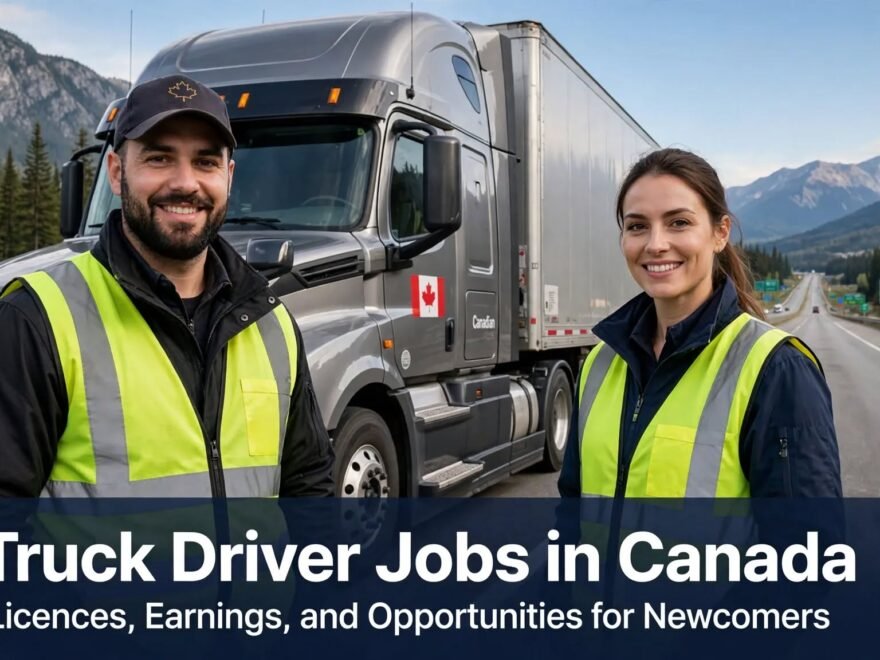
Truck Driver Jobs in Canada: Canada is the second-largest country on Earth, and almost everything its people buy, from groceries to building materials, travels at some point on the back of a truck. That simple fact makes truck driver jobs in Canada some of the most stable work in the country. An aging workforce, long distances, and steady freight demand keep employers hiring.
If you’re a newcomer or an experienced driver abroad, the idea is appealing. But the reality is more detailed than the glossy “visa-sponsored trucking jobs” ads suggest. You’ll need a Canadian commercial licence, and Canadian immigration rules around trucking have shifted recently. There are also scammers who target hopeful drivers.
This guide covers the licences you need, what drivers actually earn, the immigration routes that still work, and how to find a legitimate job.
Why Trucking Remains a Strong Career Choice
Transport truck drivers fall under NOC 73300, the national classification Canadian employers and immigration officers use. The work is steady for a few reasons:
- Geography drives demand. Freight moves across thousands of kilometres between ports, farms, mines, and cities.
- Many drivers are nearing retirement, so companies need replacements.
- Benefits are common. Job Bank data shows roughly 79.5% of workers in this occupation receive at least one non-wage benefit such as health coverage or paid leave. jobbankjobbank
- Entry barriers are lower than many skilled careers. You don’t need a university degree, though you do need formal training and a licence.
Trucking is also physically and mentally demanding. Long hours, time away from family, and winter driving are part of the job. Be honest with yourself about that before you commit.
Read Also: Cashier and Food Service Jobs in Canada: Entry-Level Roles with Fast Hiring
Types of Truck Driver Jobs You’ll Find
Not every trucking job means weeks on the highway. Newcomers often start in lighter roles and move up.
Entry-Level Roles
- Yard or shunt driver: moves trailers around a depot or warehouse yard.
- Local delivery driver: straight trucks, often home-based nightly.
- Driver’s helper or second driver: supports a senior driver and builds experience.
Mid-Level and Experienced Roles
- Regional driver: covers one province or neighbouring regions, with regular home time.
- Long-haul (over-the-road) driver: crosses provinces or enters the United States, with the highest earning potential.
- Specialized driver: tanker, flatbed, refrigerated, dangerous goods, or heavy haul. These usually pay more but require extra endorsements or experience.
Independent Options
- Owner-operator: you own or lease your truck and contract with carriers. Income can be high, but so are insurance, fuel, and maintenance costs. This is not a good first step for someone new to the country.
Understanding Canadian Truck Licences
Licensing is the biggest hurdle for newcomers. Your immigration status lets you live and work in Canada, but only a provincial commercial licence lets you legally drive the truck. Each province issues its own licences, though the system is broadly similar.
The Licence Classes You Need to Know
| Province | Tractor-trailer licence | Notes |
|---|---|---|
| Ontario | Class AZ | “Z” is the air brake endorsement |
| Alberta, BC, Saskatchewan, Manitoba, most others | Class 1 | Air brake endorsement is usually separate |
| Quebec | Class 1 | Quebec has its own rules and requires French in many workplaces |
A Class 1 (or AZ) licence allows you to drive a tractor-trailer combination. Class 3 covers straight trucks with two or more axles, which suits local delivery work and is a good stepping stone.
Can You Convert a Foreign Licence?
In most cases, no. A licence from India, Pakistan, the Philippines, or most other countries generally cannot be swapped for a Canadian Class 1. You’ll typically need to pass the knowledge test, complete mandatory training, and take the road test. Some licences from certain countries or U.S. states have special exchange agreements, so check your province’s licensing agency for specifics.
Mandatory Entry-Level Training (MELT)
Canada has tightened training standards for new Class 1 drivers. Mandatory Entry-Level Training (MELT) requires you to complete an approved course before you can sit your road test. In Ontario, it has applied since 2017, and the standard requires well over 100 hours across classroom, in-yard, and on-road instruction. Other provinces use similar programs. Details change, so confirm hours and approved schools with your provincial ministry before paying anyone.
Step-by-Step: Getting Your Class 1 Licence
- Hold a valid base licence (usually a standard car licence, such as Class G in Ontario) in good standing.
- Pass a medical examination confirming you meet commercial driver fitness standards.
- Obtain a driver’s abstract (your driving record) if the province requires it.
- Pass the written knowledge tests, including air brakes.
- Enrol in an approved MELT school and complete the required hours.
- Pass the road test with a licensed examiner.
- Earn endorsements (such as dangerous goods or tankers) if the job requires them.
Language Matters
Commercial drivers must read road signs, understand regulations, complete logbooks, and communicate with inspectors and dispatchers. English (or French in Quebec) proficiency is a practical requirement and a legal expectation. Strong language skills also help immigration scores.
How Much Do Truck Drivers Earn in Canada?
This is what most people want to know, so here are real numbers rather than promises.
According to Job Bank’s wage data for transport truck drivers, the national figures are about $19.45 per hour at the low end, $26.42 median, and $37.00 at the high end. The data was last updated in November 2025. jobbank
Provincial Differences
Wages vary noticeably by region:
- British Columbia: median around $30.77 per hour jobbank
- Alberta: median around $30.00 per hour jobbank
- Saskatchewan: median around $27.00 per hour jobbank
- Ontario: median around $26.00 per hour jobbank
- Manitoba and the Maritimes: medians closer to $23–$25 per hour jobbank
- Northern territories: often higher, with the Yukon median near $34.00 per hour, reflecting remote conditions jobbank
What That Means Annually
At the national median of about $26 per hour and a 40-hour week, you’d earn roughly $54,000 per year before tax (my calculation). Long-haul drivers who work 45 to 60 hours, or who are paid per kilometre, can earn substantially more. Starting drivers should expect the lower end of the range for the first year or two.
How Truckers Are Paid
- Hourly: common for local and regional work, with overtime rules varying by province.
- Per kilometre or mile: typical for long-haul. Ask how deadhead and waiting time are handled.
- Percentage of load: more common for owner-operators.
- Bonuses and benefits: safety bonuses, health plans, and pension contributions can add real value.
Tip: Always compare the total package, not just the headline rate. A $30 hourly job with unpaid waiting time may pay less than a $27 job that pays for every hour worked.
Immigration Pathways for Truck Drivers: What Has Changed
Here’s where many online articles are out of date, so read this part carefully.
Express Entry’s Transport Category No Longer Includes Truck Drivers
Truck drivers were eligible for targeted Express Entry transport draws in 2023 and 2024. That is no longer true. The rebuilt 2026 Transport category covers just four occupations, and truck drivers, the largest group under the old category, are not among them. The updated list focuses on aviation and vehicle maintenance roles instead. Any website still promising “special CRS cut-offs for truck drivers” is using outdated information. earnestimmigration
Truck drivers can still apply through general Express Entry draws, but they compete on points with every other candidate, and cut-offs for general draws have been high in 2026.
Provincial Nominee Programs (PNPs)
Provinces with trucking shortages sometimes run streams that favour drivers with a job offer. Programs and eligibility change frequently, so check each province’s official immigration website. Alberta, Saskatchewan, Manitoba, and Atlantic Canada have historically been more receptive, but nothing is guaranteed.
More alos: Window Cleaner Jobs in Canada
Atlantic Immigration Program
This employer-driven program lets designated employers in Atlantic Canada hire workers and support their permanent residence applications. It can suit drivers willing to settle outside the big cities.
Temporary Work Through an LMIA
Many newcomers enter through a Labour Market Impact Assessment (LMIA)-supported work permit, where a Canadian employer proves no suitable local worker was available. Here’s what to know:
- The employer applies for the LMIA, not you.
- Job Bank lists postings marked as LMIA requested or approved.
- Rules for lower-wage LMIAs have tightened in areas with higher unemployment, so availability varies by region.
- A genuine employer never charges you to be hired. Paying someone for a “guaranteed LMIA” is the classic scam.
Already in Canada?
If you come on a work permit and gain Canadian driving experience, you may later qualify for Canadian Experience Class or provincial programs. Canadian work history adds real value to a PR application.
Verify Before You Rely on Any of This
Immigration policy shifts quickly. Always confirm requirements on the IRCC website or with a regulated professional such as a licensed immigration consultant (RCIC) or lawyer.
How to Find a Real Trucking Job in Canada
Where to Look
- Job Bank (jobbank.gc.ca): the government’s official board. You can filter for postings tied to foreign worker programs.
- Company career pages: large carriers often run their own training and hiring programs.
- Industry job boards and trucking associations, such as provincial trucking associations.
- Recruiters, but only those who don’t charge candidates.
What Employers Look For
- A valid Canadian Class 1/AZ licence (or proof you’re in the process of earning one)
- A clean driver’s abstract
- Verifiable work history
- Strong English or French
- The right to work in Canada
- A positive safety attitude
Make Your Application Stronger
- Document your experience with employer letters, logbook records, and licence copies from your home country.
- Take a recognized training course early. It signals commitment.
- Be flexible on location. Prairie provinces and smaller communities often hire faster than Toronto or Vancouver.
- Start in a local or regional role to build Canadian experience before pursuing long-haul work.
Avoiding Common Scams
Scammers know how badly many people want to move to Canada. Watch for these red flags:
- Anyone asking for payment to arrange a job offer or LMIA
- Promises of guaranteed PR for a fee
- Job offers that arrive without any interview
- Fake government websites or lookalike email addresses
- Pressure to pay quickly or to send money by wire or gift card
Verify any employer through Job Bank, the provincial business registry, and the company’s official website before sharing documents or money.
Life on the Road: What to Expect
Knowing the lifestyle helps you decide if this career fits.
Advantages
- Strong demand and job security
- Benefits and overtime potential
- Independence on the road
- Clear paths toward better-paying specialized work
Challenges
- Time away from home, especially in long-haul work
- Harsh winters, including snow, ice, and mountain passes
- Strict hours-of-service rules enforced through electronic logging devices
- Physical strain from long sitting hours and loading work
- Pressure on delivery schedules
Many drivers find the balance works well, especially once they move into regional or local routes.
Practical Tips for Newcomers
- Budget for training costs. MELT courses can cost several thousand dollars, so plan ahead.
- Study the driver’s handbook for your province thoroughly.
- Learn winter driving techniques before your first season.
- Keep your abstract clean. Employers and insurers watch it closely.
- Join driver communities, both online and in your local area, for practical advice.
- Plan your pathway (licence, job, then PR) rather than expecting one step to solve all three.
Conclusion
Truck driver jobs in Canada offer steady demand, decent pay, and real opportunity, but the route for newcomers requires patience and homework. You’ll need a Canadian commercial licence, which usually means completing mandatory training. And while earnings are solid, with a national median of about $26 per hour, entry-level pay starts lower. Immigration is trickier than it once was, because truck drivers have lost their special Express Entry category.
The best approach is to treat licensing, employment, and immigration as three separate tasks, verify everything with official sources, and never pay anyone for a job offer. Drivers who prepare carefully and stay flexible about location often build stable, well-paid careers.
Frequently Asked Questions (FAQ)
1. Can I drive a truck in Canada with a foreign licence?
Generally no. You’ll need to earn a Canadian Class 1 or AZ licence, which typically requires testing and mandatory training. A few exchange agreements exist, so check with your provincial licensing agency.
2. How much do truck drivers make in Canada?
Job Bank reports a national median of about $26.42 per hour, with a typical range from roughly $19 to $37. Western provinces and the territories generally pay more. jobbank
3. Are truck drivers still eligible for Express Entry?
Yes, through general draws. However, truck drivers are no longer part of the 2026 Transport category draws, so there are no special lower cut-offs for them. earnestimmigration
4. Is an LMIA the only way to get a visa-sponsored trucking job?
No. Other options include provincial nominee programs and the Atlantic Immigration Program. Eligibility depends on your profile and the province.
Read Also: Warehouse Supervisor Jobs in Canada
5. How long does it take to get a Class 1 licence?
It depends on the school and your preparation, but plan for several weeks to a few months to complete training and testing.
6. Do I need to speak English or French?
Yes. You’ll need to read signs, complete logbooks, and communicate with inspectors and dispatchers. It also improves your job and immigration prospects.
7. Should a newcomer become an owner-operator right away?
Usually not. Truck, insurance, and fuel costs are high, and local knowledge matters. Most newcomers start as company drivers.
Disclaimer: This article is for general information only and is not legal or immigration advice. Rules change often, so confirm details with IRCC, your provincial licensing authority, or a regulated professional.
One comment